Healing Doesn’t Make Life Easier
Healing Doesn’t Make Life Easier
It Changes the Way You Meet Life
There’s a quiet promise many of us make to ourselves when we begin a journey of personal growth. We rarely say it out loud, but somewhere beneath the surface, we begin to believe that if we heal enough, life will eventually stop hurting. We imagine there will come a day when difficult conversations no longer affect us, disappointment rolls off our shoulders, fear disappears, and uncertainty loses its ability to shake our confidence.
It’s an understandable belief. After all, why would we spend so much time learning, growing, healing, and working on ourselves if not to create a more peaceful life?
Over the years, however, I’ve come to understand one of the greatest misconceptions about healing: we think healing is supposed to make life easier. It isn’t.
Life continues to unfold as life always has. There are seasons of joy and seasons of grief. Relationships change. Plans fall apart. People disappoint us. Doors close that we were certain were supposed to open. Unexpected circumstances arrive and remind us that no matter how intentional we become, there will always be parts of life we cannot control.
None of us are exempt from being human. Healing doesn’t change that. What healing can change is the person who meets those experiences.
There was a time when difficult situations could completely consume me. I would replay conversations in my mind, question myself, worry about what might happen next, or search outside of myself for answers and reassurance. Somewhere along the way, I had begun to believe that peace was a destination I would eventually reach if I simply worked hard enough on myself.
What I didn’t understand was that healing was never asking me to create a life without uncertainty. It was teaching me how to remain connected to myself within uncertainty.
That is a very different kind of healing.
Healing Changes Your Relationship With Life
Self-cultivation isn’t about building a life where nothing difficult ever happens. It’s the lifelong practice of developing yourself from the inside out so that when life inevitably shifts, you don’t lose yourself in the process.
You begin to notice what is happening within you before automatically reacting to what is happening around you. You recognize the stories your mind is creating without assuming every one of them is true. You become curious about your emotional reactions instead of judging yourself for having them. And eventually, you begin to see that some of life’s most uncomfortable moments can reveal exactly where something within you is asking for attention.
This doesn’t mean ignoring your emotions or pretending everything is okay. True healing asks the opposite of us. It asks us to become honest about what we are feeling without allowing those feelings to become the author of our lives.
We can acknowledge fear without allowing fear to make every decision. We can experience sadness without concluding that hope has disappeared. We can feel uncertainty without immediately trying to control the outcome. We can be disappointed and still trust ourselves enough to take the next step.
That, to me, is resilience.
Resilience Isn’t the Absence of Struggle
Resilience is often mistaken for toughness. We admire people who appear unshaken by adversity and assume they possess some extraordinary strength that the rest of us lack. But the most resilient people I have known are not the ones who never struggle. They are the ones who have learned how to find their way back to themselves when they do.
They allow themselves to grieve without making grief their permanent home. They acknowledge disappointment without allowing one experience to define what is possible next. They recognize when they need rest, support, boundaries, or space. And when they lose their footing—as all of us sometimes do—they know that losing their footing is not the same as losing themselves.
Resilience isn’t about becoming unaffected by life. It’s about developing the inner capacity to move through life without abandoning yourself.
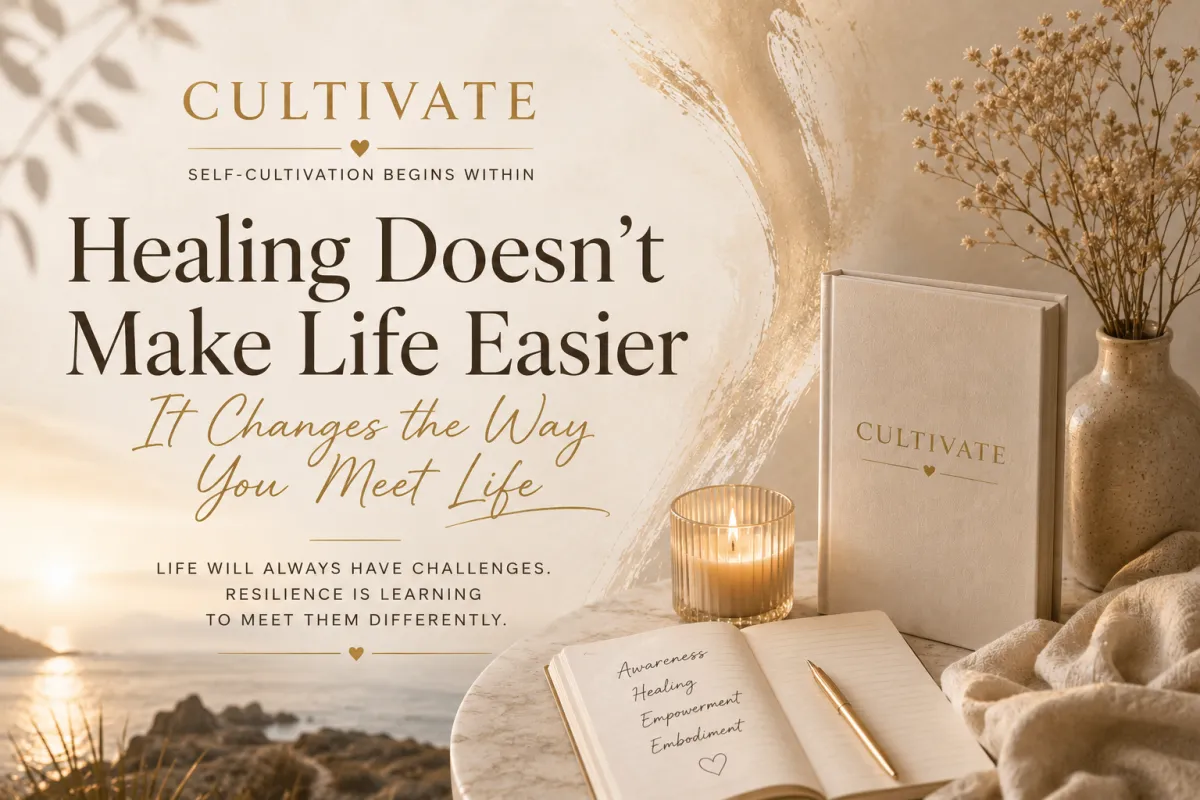
I believe this is exactly what the Four Pillars of CULTIVATE—Awareness, Healing, Empowerment, and Embodiment—are designed to help us practice.
The Four Pillars in Real Life
Awareness is where meaningful transformation begins because we cannot consciously change what we are unwilling or unable to see. Awareness allows us to observe our thoughts, emotions, behaviors, and patterns with curiosity rather than judgment. It creates space between what happens to us and what we do next. Within that space, we begin to discover that we have more choice than we once believed.
Healing naturally follows awareness. Once we can see the patterns, beliefs, wounds, and protective responses we have been carrying, we can begin addressing them with compassion rather than criticism. Healing isn’t about erasing our past or pretending painful experiences never happened. It is about changing the relationship we have with those experiences so they no longer unconsciously direct our present.
From healing comes Empowerment. Empowerment is the recognition that while we cannot control every circumstance, we still have agency over how we participate in our own lives. We can choose our boundaries. We can question an old belief. We can pause before responding. We can make a different decision than the one we have made a hundred times before. Sometimes empowerment is dramatic, but more often it is found in these quiet moments when we realize, I have another choice.
And with practice, those choices become Embodiment. What once required tremendous conscious effort begins to become part of how we live. Awareness becomes more natural. Boundaries become an expression of self-respect rather than something we feel guilty for creating. We recognize our patterns sooner. We recover more quickly when something knocks us off balance. We stop merely understanding what we have learned and begin living it.
This is why I believe self-cultivation matters most when life is not going according to plan.
Your Nervous System Is Part of the Conversation
There is also a physiological component to the way we meet life. When our nervous system perceives threat or becomes overwhelmed, our responses can become more automatic. We may become defensive, impatient, anxious, withdrawn, hypervigilant, or desperate to regain control.
These responses are not necessarily reflections of who we are at our core. Often, they are protective responses from a system attempting to keep us safe.
This is one reason awareness is so powerful. When we begin noticing what is happening in the body—not only what is happening in the mind—we gain another opportunity to interrupt an automatic pattern.
Maybe the jaw tightens. The chest feels heavy. The breath becomes shallow. The heart begins racing. We feel an immediate urge to defend ourselves, withdraw, fix the situation, or make the discomfort disappear.
Instead of immediately following that impulse, we can learn to notice it.
Over time, creating greater internal safety and regulation can give us more space between stimulus and response. The external circumstance may not have changed at all, yet our experience of it can become remarkably different because the person meeting the circumstance has changed.
Healing Is Not Perfection
I think this is where many of us can become unnecessarily hard on ourselves. We believe that because we have “done the work,” we shouldn’t be triggered anymore. We shouldn’t feel afraid. We shouldn’t become angry. We shouldn’t fall back into an old pattern.
But healing is not proven by never being triggered again.
Sometimes healing looks like recognizing the pattern sooner. Sometimes it means taking ten minutes to regulate yourself instead of carrying an argument for three days. Sometimes it is realizing that the story your mind is telling you isn’t necessarily true. Sometimes it is apologizing. Sometimes it is setting a boundary. Sometimes it is choosing not to respond at all.
And sometimes healing simply means extending compassion to yourself when you realize you are still learning.
There is tremendous freedom in allowing growth to be a practice rather than a performance.
Perhaps that is what healing has been trying to teach us all along. Not that life will become easier, but that we can become more present within it. More compassionate. More discerning. More grounded. More trusting of ourselves. And ultimately, more capable of meeting life as who we truly are rather than solely through the conditioning we have accumulated along the way.
There will always be another challenge somewhere on the horizon. That is part of being alive. The invitation isn’t to avoid those moments. It is to meet them differently than we did before.
Every experience gives us another opportunity to practice awareness, choose healing instead of repeating an old pattern, step into our own empowerment, and eventually embody a different way of living.
Life isn’t asking us to become fearless. It’s asking us to remain present—one conscious choice at a time.
A Moment of Reflection
Before you continue with your day, take a moment to consider the challenge that feels most present in your life right now. Notice what happens when you think about it. What does your mind immediately tell you? What happens in your body? What emotion comes forward? And what do you feel compelled to do?
Rather than asking, “Why is this happening to me?” try asking:
“How is this experience inviting me to grow?”
Then go one step further: “Who do I want to be as I move through it?”
That question shifts our attention away from controlling the circumstance and toward cultivating the person who is meeting it. Sometimes that shift in perspective is enough to change the experience itself.
Continue Your Self-Cultivation Journey
If this article resonated with you, you may be curious about which area of your own self-cultivation is asking for greater attention right now. The Four Pillars—Awareness, Healing, Empowerment, and Embodiment—work together, but at different times in our lives, one may be calling us more strongly than the others.
I invite you to Take the Self-Cultivation Assessment to discover where you may be in your journey and which pillar may offer the greatest opportunity for growth right now.
And if you’d like to continue exploring self-cultivation, conscious living, whole-body wellness, and practical ways to create meaningful change from within, Join the Community to Start Your Journey.
Self-Cultivation Begins Within.